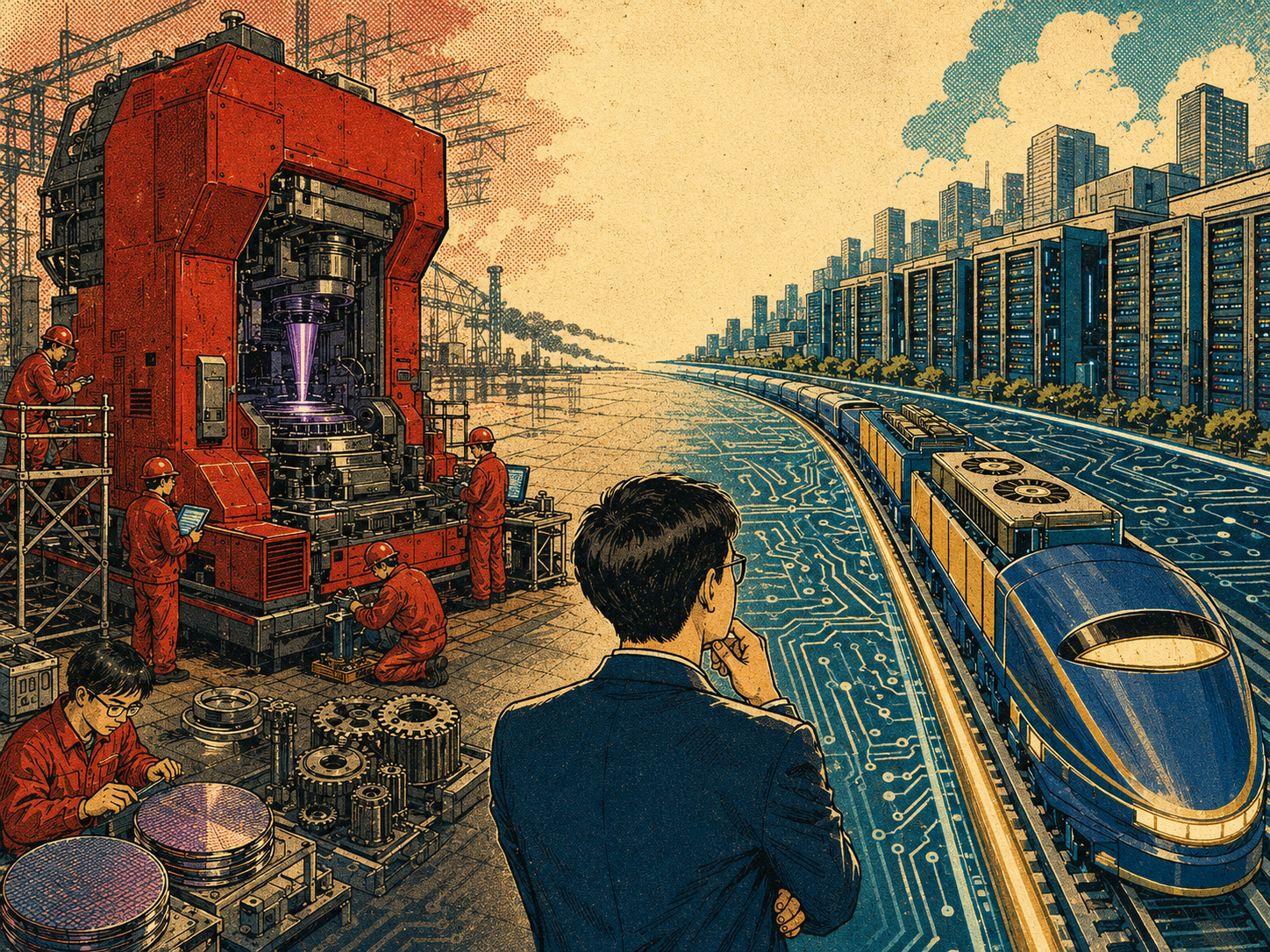
- China just took a big step toward making its own chip-making machines. Here's what it means for Samsung, SK Hynix, and the AI chip boom — in simple English.
China Just Got Closer to Making Its Own Chip Machines
There is big news in the chip world. A company backed by the Chinese government is getting ready to make immersion DUV machines. These machines are used to print tiny circuits on silicon chips.
The plan is small at first: 5 machines in 2026, and 20 machines in 2027.
The main customers will likely be SMIC (China's biggest chip factory) and CXMT (a Chinese memory chip maker).
It is too early to call this a full success. The machines still need to prove they can run smoothly in real factories, with good speed and few mistakes. But this news is still important. It shows that China keeps moving toward making its own chip equipment, step by step.
What Is Immersion DUV, and How Far Has China Come?
DUV stands for "deep ultraviolet." It is a type of light used to draw very small circuit patterns on silicon wafers.
Immersion DUV adds a layer of liquid between the lens and the wafer. This makes the picture sharper. It is used to make chips at the 7nm, 14nm, and 28nm level — not the newest chips, but still very useful ones.
Right now, one company controls almost this whole market: ASML, based in the Netherlands. In 2025 alone, ASML shipped 131 immersion DUV machines. Compare that to China's goal of just 5 machines in 2026 and 20 in 2027. The gap is still huge.
Building a machine is one thing. Using it every day in a real factory — with good output and few broken chips — is a much harder problem. So it would be a mistake to think China can replace ASML anytime soon.
Not Brand New News, But Still Meaningful
China has been working on this for a while. Back in 2025, reports said a company called SiCarrier, believed to be linked to Huawei, was developing a 193nm immersion DUV machine in Shanghai. This new production plan seems to come from that same team.
In terms of raw technology, China's machine is still behind ASML's best equipment today. Experts say China's current level looks similar to where ASML was around 2008.
That is far from cutting-edge. But it is still an important starting point. It means China's chip industry now has the basic tools to build and improve its own equipment over time.
China's Push for Chip Independence Is Hard to Stop
China faces strict export rules from the United States. It is getting harder for China to buy advanced chips — and also harder to buy the machines used to make chips, like lithography, etching, and deposition equipment.
For China, making its own chip equipment is no longer a choice. It has become a matter of survival.
Over time, China's ability to make its own chips will likely keep growing. This is a real, long-term risk for Korea's chip industry.
As Chinese companies build up their own equipment, materials, memory, and factory skills, Samsung Electronics and SK Hynix may face more competition — especially in basic memory chips and older, mature-node chips, where Chinese firms could compete hard on price.
This is also bad news, long-term, for global chip equipment makers like ASML. If Chinese customers switch to Chinese-made machines, ASML's sales in China could shrink.
But Don't Mix This Up With the AI Chip Boom
Here is the key point: China's DUV progress is a different story from today's AI chip boom.
The current chip rally is being driven by U.S. hyperscalers and Nvidia. Companies like Microsoft, Google, Amazon, and Meta are pouring money into AI data centers, built around Nvidia's GPUs. That is why demand for HBM and server DRAM has jumped so fast.
In short, this cycle is about U.S. tech giants and their data center spending — not about China's ability to make everyday chips.
China producing a few DUV machines won't change Microsoft's or Google's data center budgets. Their spending plans are not likely to shift just because of China's equipment progress.
AI Chips Are Not Simple, Swappable Products
AI chips and server memory chips are not like basic goods you can swap out just because the price is right. Quality and reliability matter enormously.
In a data center, even a small defect can cost a huge amount of money. If a server crashes or breaks down, repair and downtime costs add up fast. This is called Total Cost of Ownership (TCO).
The quality and failure rate of chips used in AI servers directly affects TCO. That means new chips need years of testing before they can be trusted in real data centers.
Being able to manufacture a chip is not the same as being accepted into the U.S. data center supply chain. A company must prove performance, yield, reliability, supply capacity, and customer support — all at once.
Geopolitics Adds Another Wall
Chinese chip companies also face political risk. It is very hard to imagine major U.S. data centers using large amounts of Chinese-made AI chips or Chinese server memory anytime soon.
This isn't just about technical testing. Security concerns, supply chain rules, and government regulations all stand in the way.
Even if China's chip technology keeps improving fast, entering the U.S.-centered AI data center world means clearing a very high bar. So it would be an overreaction to think China's DUV progress will hurt Nvidia's or other U.S. chipmakers' earnings right away.
When the Tail Wags the Dog
After news like this, investors sometimes panic and sell not just equipment makers, but U.S. semiconductor stocks broadly.
But letting China's DUV news shake the entire U.S. AI chip market is a bit like the tail wagging the dog.
China's equipment progress is a real, long-term risk. But it is not the main force driving today's AI chip cycle.
If the market overreacts to this kind of news, it may say more about fragile investor sentiment than about China's actual impact. When small bad news causes big stock swings, it's often a sign investors are already nervous about a possible market top.
China Is a "Next Bottom" Risk, Not a "Current Top" Risk
China's semiconductor growth is not really about when this AI cycle ends. It's more about how deep the next downturn could go.
As China's production capacity grows, any future oversupply in memory chips could push prices down even further. If China ramps up supply of basic DRAM, NAND, and mature-node chips, competition will likely get much tougher during the next downturn.
This adds long-term pressure on the profits and valuations of the three big memory makers: Samsung, SK Hynix, and Micron. The fact that these three stocks currently trade around a P/E ratio of roughly 5 may already reflect the market pricing in this long-term risk.
What Investors Should Really Watch Right Now
The most important signal right now isn't how many DUV machines China builds. It's whether the AI chip cycle has actually peaked.
To check that, watch the capital spending plans of U.S. hyperscalers. Are Google, Microsoft, Amazon, and Meta still increasing AI data center investment? Is Nvidia's GPU demand holding steady? Are HBM and server DRAM orders staying strong?
If AI data center spending keeps growing, this chip cycle likely continues. If hyperscalers start cutting investment, or doubts grow about data center profitability, then the "peak cycle" debate will heat up.
China's DUV progress is not the deciding factor in that debate.
The Bottom Line
China's move into immersion DUV machines is a meaningful development. It shows China is steadily working toward chip equipment independence, and it could become a long-term burden for Korea's chip industry and global equipment makers.
But this issue should not be directly linked to today's AI chip cycle.
China's DUV progress is a long-term industrial competition story. Today's AI chip cycle depends on U.S. hyperscaler data center spending and the Nvidia-centered ecosystem.
China's growth may determine how deep the next downturn goes. But to judge whether this cycle has already peaked, investors need to watch a different set of signals.
That's why it's important to keep China's chip equipment story separate from the AI semiconductor cycle story.
Keywords: China DUV lithography, SK Hynix, Samsung Electronics, AI semiconductor cycle, ASML, chip equipment localization, HBM memory chips


댓글